
How to Check Criminal History in Clinch County
No single Clinch County criminal records portal joins every report, booking, warrant, court filing, and state history. Begin with the kind of answer needed. The Clerk of Superior Court holds filed felony cases and final judgments. The Clinch County Sheriff's Office and jail handle sheriff reports, current custody, bookings, and sheriff warrant questions. Homerville Police retains its own incident material. GCIC maintains Georgia's identity-linked criminal history, while GDC tracks people in state correctional jurisdiction.
Gather a full legal name, spelling variants, date of birth when lawfully available, the approximate event date, and any case, incident, booking, or state identification number. Exact identifiers help separate people with similar names. Then follow the source trail:
- Choose the custodian based on whether the issue is an incident, booking, court case, state history, or correctional status.
- Search the official channel or call the office. Use exact numbers before relying on a name-only match.
- Read dates and labels closely. A booking charge is an allegation, while a disposition states how the filed charge ended.
- Ask the originating office for the source record when a summary lacks detail or two systems conflict.
- Order a certified court disposition when formal proof of a Clinch County case outcome is needed.
Four Clinch Criminal Record Custodians
Clinch County criminal records split into four main lanes. The sheriff or arresting police agency explains the incident and arrest. The jail records intake, bond, release, and current custody. The Superior Court clerk records charges that were filed, docket events, judgment, and sentence. GCIC links fingerprint-supported arrest cycles with dispositions reported by participating agencies. GDC becomes relevant after a state sentence or while a person remains within Georgia correctional jurisdiction.
The records can differ without any one of them being false. Prosecutors may amend or decline a booking allegation. A court may enter a disposition before it reaches GCIC. A GDC profile may remain as correctional history after release. Use the Clinch County criminal court case file to establish what was formally charged and how that case ended.
| Source | Best answer | Main limit |
|---|---|---|
| Sheriff or police | Incident and arrest facts | Not the final case outcome |
| County jail | Booking and custody status | No official online Clinch roster |
| Superior Court clerk | Filed charges and disposition | Not every unfiled arrest |
| GCIC or GDC | State history or corrections data | Different scope and reporting schedules |
Official Georgia Background Checks
The Georgia Bureau of Investigation's Georgia Crime Information Center is the state repository. A person reviewing their own Georgia criminal record may use a fingerprint-supported personal review through a participating sheriff or police department. Call the Clinch County Sheriff's Office before visiting because its fingerprint hours, identification rules, appointment process, and local charge are not posted.
Georgia Felon Search is a narrower public name-based product. It requires first name, last name, date of birth, sex, and card payment. The fee is $15 even when no record appears, plus $15 for each possible-match record opened. It omits misdemeanors, juvenile history, restricted records, and non-conviction data. GCHEXS is different: it routes authorized fingerprint checks by an agency or program code and is not an open public name search.
The official Georgia Felon Search screen shown here illustrates the state conviction channel.
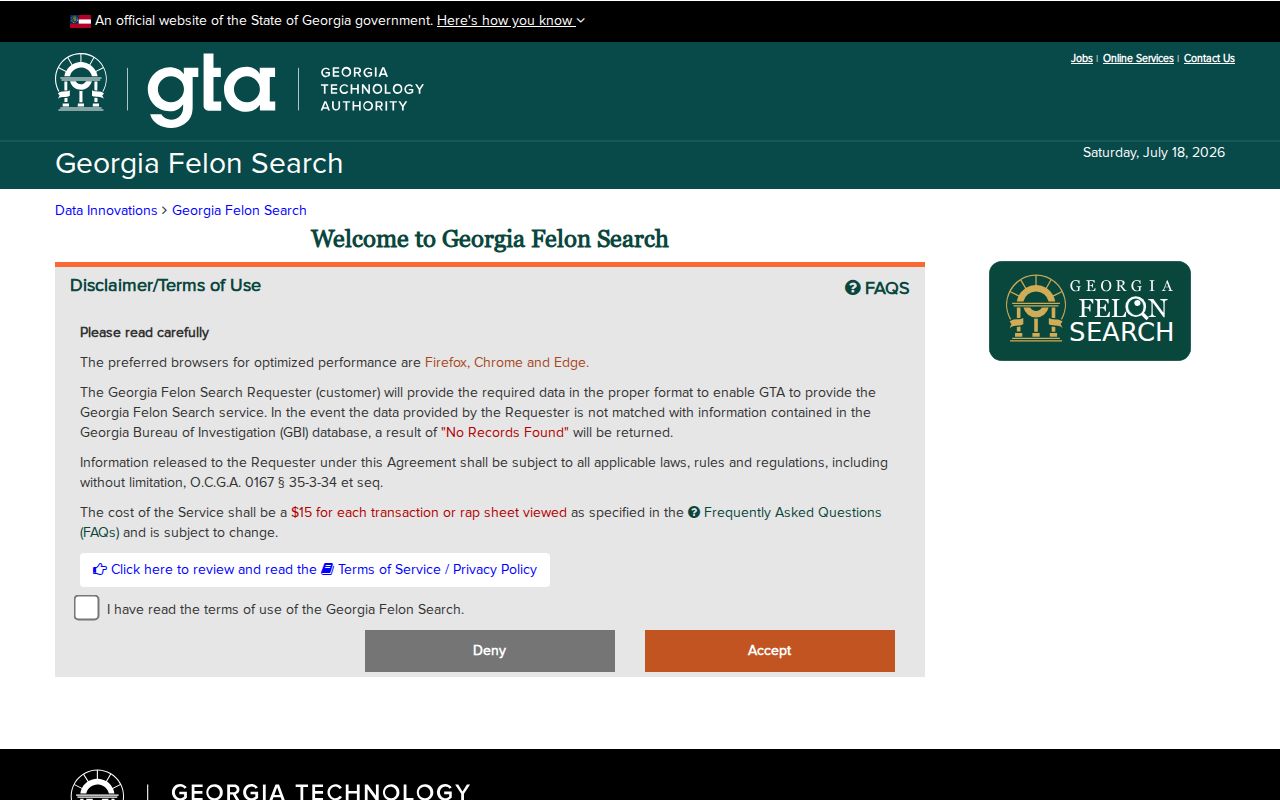
Its limited scope is why a possible match should be compared with the Clinch County court disposition and, for self-review, an identity-confirmed GCIC record.
Clinch Criminal Booking Fallbacks
Clinch County publishes no official live jail roster, recent-booking page, warrant search, or sheriff app. For a recent booking, call Clinch County Jail at 912-487-5316. Give the full legal name and another identifier if staff asks. Confirm the booking date, arresting agency, charges as entered at intake, bond, custody status, and release details. Then request the booking sheet or other releasable material from the sheriff at 115 Court Square, Homerville, GA 31634; fax 912-487-3602.
Next, obtain the incident or arrest report from the agency named in the booking. Check the clerk after charges are filed. Georgia VINELink may offer custody notifications where the participating agency supplies data, but it is a supplement. GDC Find an Offender is for the state correctional population, not a live Clinch County jail list. The detailed Clinch County arrest history route covers those source differences.
The official GDC offender search shown here is useful only when state correctional jurisdiction fits the question.
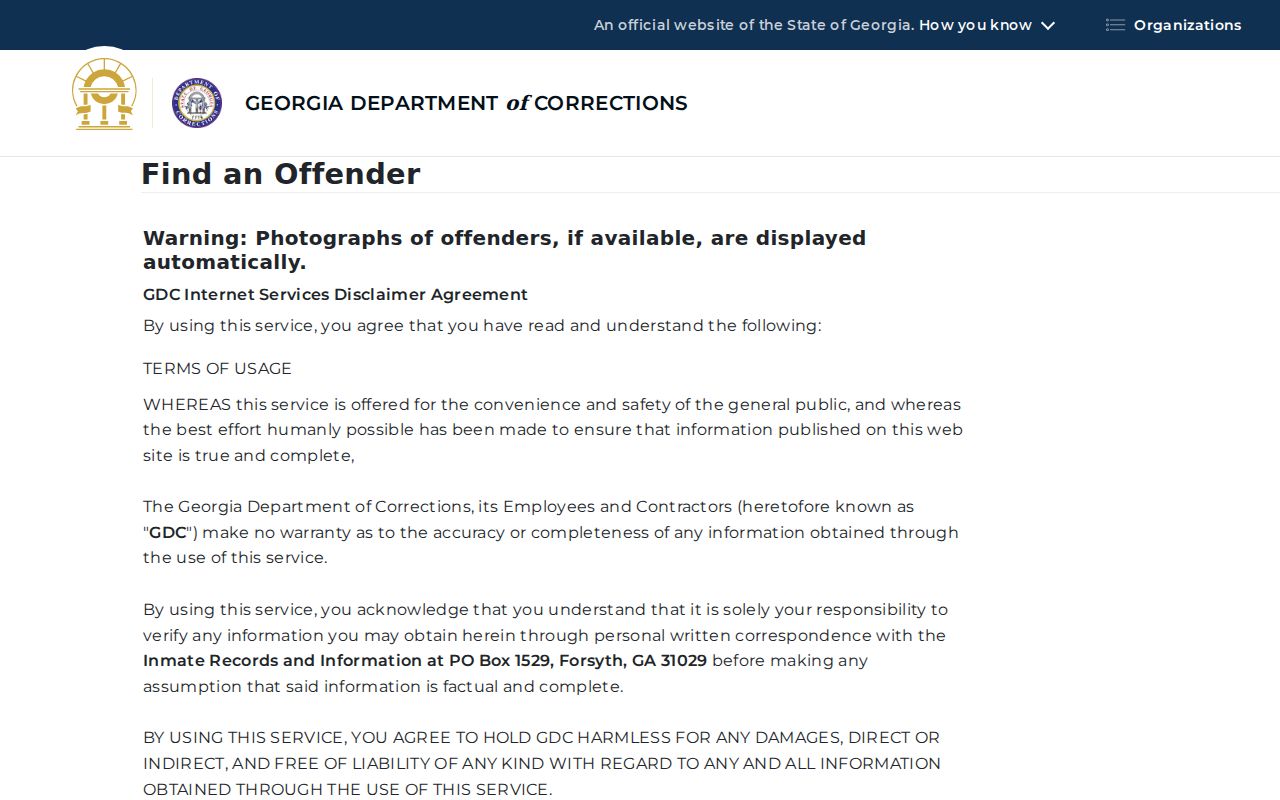
A missing GDC result says nothing conclusive about a new county booking, an unfiled arrest, or a person held outside the state prison system.
Types of Criminal Records
A record type describes both its purpose and its custodian. Clinch County incident reports preserve an agency's account of an event and may exist without an arrest. Arrest reports state the claimed legal basis, time, place, officer, and alleged offense. Jail booking records document intake and custody. Warrants come from courts and law enforcement systems, while a criminal court file tracks the charge after filing.
State products add different layers. GCIC history links fingerprint-supported arrest cycles and reported outcomes. GDC offender records concern state custody and sentence data. Sex offender registry profiles serve a specific public-safety function. Probation and parole information combines the judgment with supervision data, much of which is not open online.
- Booking charge
- The allegation delivered to jail staff at intake, not a finding of guilt.
- Disposition
- The court result for a filed charge, such as dismissal, acquittal, plea, or judgment.
- Arrest cycle
- A fingerprint-linked GCIC segment that joins an arrest with later reported action.
- Certified copy
- A clerk-authenticated court record used when an ordinary screen image is not enough.
Clinch Criminal Records at Court Square
Clinch County's core record offices sit in a compact Court Square cluster in Homerville. The Clerk of Superior Court at 25 Court Square, Suite C, keeps felony cases, docket papers, judgments, criminal warrants in court files, older records, and certified copies. The office phone is 912-487-5854 and fax is 912-487-2316. The Clinch County Sheriff's Office and jail are nearby at 115 Court Square, with phone 912-487-5316.
These counters do different work. Ask the clerk for filed case records and final dispositions. Ask the sheriff or jail about sheriff-created reports, booking, custody, and service or warrant administration. Magistrate Court at 110 Court Square, 912-487-2514, handles arrest and search warrants, first proceedings, and bail within its authority. Since Clinch County dates to 1850 and has a long paper-record history, an empty online result should lead to a clerk call rather than a claim that no file exists.
Superior Court Clerk
25 Court Square, Suite C
Homerville, GA 31634
912-487-5854
Sheriff and Jail
115 Court Square
Homerville, GA 31634
912-487-5316
Magistrate Court
110 Court Square
Homerville, GA 31634
912-487-2514
What a Clinch County Criminal Record Shows
A GCIC-style criminal history can contain legal names and aliases, birth and physical identity data, a state identification number, an FBI number, and fingerprint transaction identifiers. Each arrest cycle may show arrest date, arresting agency and ORI, charges, prosecutor action, court number, disposition, sentence, and correctional status. Public versions suppress data visible to criminal justice users.
Clinch County source files add the proof behind that summary. The incident report explains what the agency alleged. A booking sheet shows jail intake, bond, and release. The clerk's case file identifies the charge the prosecutor pursued and the judge or jury's result. Names alone are weak identifiers, so compare case numbers, arrest dates, the sheriff's ORI GA0320000, and certified final dispositions.
| Name and identifiers | Legal name, aliases, birth data, SID, FBI number, or transaction number where authorized. |
|---|---|
| Arrest and booking | Date, agency, intake charges, booking number, bond, custody, and release data held by the source. |
| Charges | Alleged offenses at arrest and the separate accusation or indictment filed in court. |
| Disposition | Dismissal, acquittal, plea, judgment, or another court result. |
| Sentence | Confinement, probation, fines, or other terms stated in the judgment. |
| Correctional status | GDC or supervision data when the person falls within that system. |
Clinch Records Beyond Felon Search
Georgia Felon Search is not a full rap sheet and not a Clinch County warrant tool. It reports a public subset of in-state felony convictions through possible name matches. A no-result screen does not clear an active warrant, prove that no misdemeanor exists, rule out a pending court case, or confirm that a past arrest was restricted. It also does not replace a fingerprint-based review of one's own record.
When the search misses a known Clinch County event, check the arresting agency, jail, and Clerk of Superior Court. If the court file has a final disposition that is missing from a personal GCIC history, obtain a certified copy and use GCIC's correction route. For federal history, the FBI Identity History Summary is a subject-only fingerprint product. Federal court cases for Clinch County belong to the Southern District of Georgia, Waycross Division, and are searched through PACER rather than PeachCourt.
Public Access Laws
The Georgia Open Records Act starts with a presumption that agency records are open, but it also permits redaction or withholding for specific protected content. A request should name the record, date range, event, and preferred copy method. Under the Act's general framework, an agency responds within three business days by producing the record or stating when it should be available and citing the basis for withholding. That is a response period, not a promise of full production within three days.
GCIC dissemination follows separate criminal-history statutes. Court files also follow judicial access rules, so a court record request goes to the clerk. Juvenile material, sealed records, active investigative information, protected victim data, medical detail, Social Security numbers, and security-sensitive content may be closed or redacted. Ask for the releasable portion when only part is exempt.
Key Georgia laws:
O.C.G.A. § 50-18-70 states Georgia's open-records policy.
O.C.G.A. § 50-18-71 governs requests, inspection, response timing, and reasonable charges.
O.C.G.A. § 35-3-35 permits defined release of Georgia felony-conviction information.
O.C.G.A. § 35-3-36 covers inspection and correction of one's own GCIC record.
Clinch Sheriff Criminal Record Requests
Clinch County does not publish a separate records-division portal, dedicated records email, working online request form, or report fee schedule. The practical route is the Sheriff's Office at 115 Court Square. Ask for a specific sheriff incident report, arrest report, booking sheet, jail entry, photograph, dispatch record, 911 audio, or video. Give an incident number, date range, location, and record type when known. A broad request for everything about a name can cause delay, clarification, and added search cost.
Call 912-487-5316 to confirm the custodian, then follow in writing if needed. Requests may also go by fax to 912-487-3602, by mail, or in person. Ask for an estimate before copies are made because local charges are not posted. For a Homerville-created report, contact Homerville Police. For a filed court case or warrant held in a court file, use the clerk rather than directing an executive-agency request to the court.
The county fallback is the Board of Commissioners at 22 Court Square, Suite B, Homerville, GA 31634; phone 912-487-2667 and fax 912-487-3658.
Sealed, Expunged & Restricted
Georgia uses the term record restriction. Under O.C.G.A. § 35-3-37, restriction can limit public access to an eligible GCIC arrest history, but it does not erase every agency copy and does not seal the courthouse file by itself. Eligibility depends on the outcome, arrest date, prosecutor action, age, later conduct, and statutory exceptions. Dismissal, acquittal, no prosecution, and some completed diversion matters may qualify, but the current law and exact case record control.
The route differs by arrest date. Pre-July 2013 arrests generally use the GCIC application through the arresting agency and prosecutor. Later matters may be processed electronically by the prosecutor. Once GCIC restriction is complete, a separate petition may be needed to seal related court records. For a Superior Court case, file with the Clinch County clerk at 25 Court Square and ask about current fees because no local amount is posted.
After an order, review both the personal GCIC history and the clerk record. If a restricted entry remains visible, send the right custodian the order plus identifiers for the exact arrest or case. Juvenile confidentiality is a separate rule, not a shortcut to adult record restriction.
Reading Clinch Criminal Record Data
Clinch County is rural, large in land area, and served by several local, regional, state, and federal agencies. That makes agency labels as important as raw counts. Sheriff, Homerville Police, Georgia State Patrol, Georgia DNR, GBI, and federal partners can each create a distinct piece of one event. County totals should not be called a city crime rate, and one agency's report should not be treated as the full county picture.
The GBI Crime Statistics program shown here provides official Georgia UCR context.
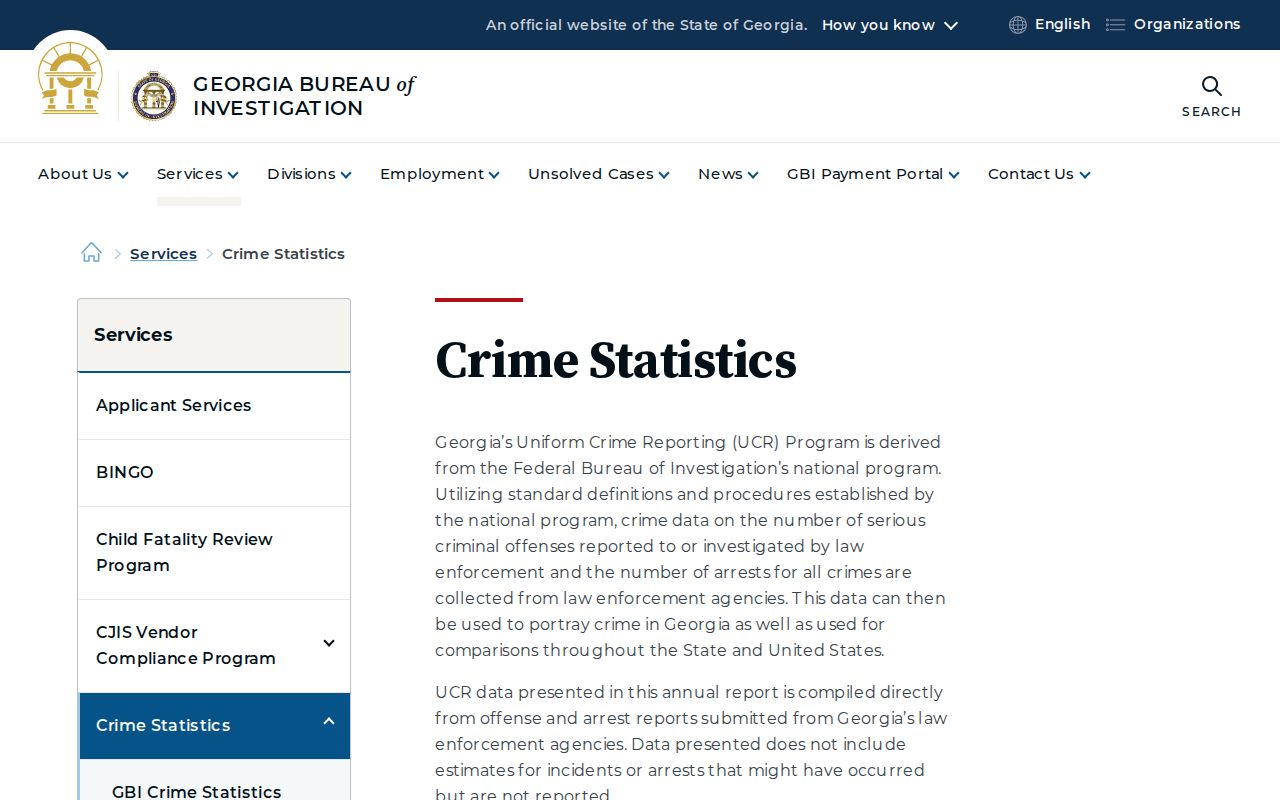
Use the reporting agency, reporting period, and offense definition before comparing figures. A case can also cross county lines. In a 2024 Thelma Highway investigation, Clinch agencies responded, but the accused was booked in Coffee County and the matter went to the Alapaha Circuit district attorney.
The FBI Crime Data Explorer shown here adds an official agency-level view.
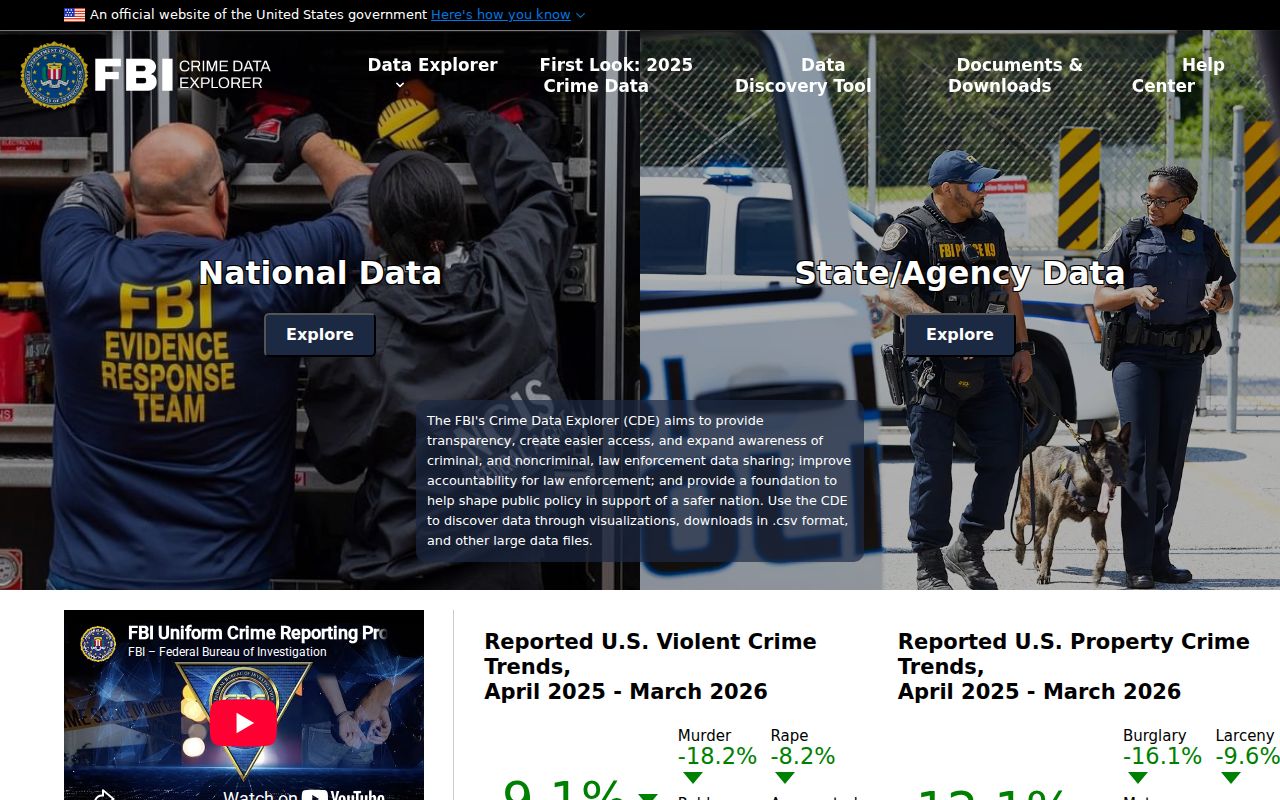
Neither data source is a person lookup. They show reported crime trends, not whether a named person was arrested, charged, or convicted.
Criminal Records by City in Clinch County
City routes vary within Clinch County. Homerville has named police, municipal court, and evidence contacts. Fargo lists a city clerk but no city police or case portal. Argyle confirms a police department yet publishes no records form or municipal lookup. The 2020 Census ranking makes Homerville, Fargo, and Argyle the three city guides, and each city still routes county bookings and felony cases to Clinch County offices.
Homerville Criminal History
2,344 residents · Named police, evidence, and municipal court contacts.
Fargo Criminal History
250 residents · City clerk and county sheriff fallback routes.
Argyle Criminal History
190 residents · Police page with City Hall request routing.
Clinch Criminal Records Across Alapaha
Clinch County belongs to the five-county Alapaha Judicial Circuit with Atkinson, Berrien, Cook, and Lanier counties. Judges and regional services cross county lines, but court files do not merge. A case that arose in another circuit county stays with that county's clerk. The Clinch County district attorney satellite may work on prosecution, while the public docket and judgment remain with the Superior Court clerk.
PeachCourt access starts through the Georgia Judicial Council's e-access directory and requires a provider account. Search with an exact case number when possible. If nothing appears, call the Clinch County clerk about spelling, older paper coverage, access limits, and certified copies. A municipal traffic matter also may not appear there because Georgia has no central traffic-citation database. Contact the court named on the citation.
This court geography matters when a Clinch event involves another jail or agency. Incident location, arresting office, booking jail, prosecutor, and final court can point to more than one counter. Record each identifier before moving to the next source.